
At Enlit Africa, one of the continent’s largest power industry renewable energy gatherings, close to four in ten exhibitor stands in Cape Town belonged to Chinese companies, more than any other nation represented, according to Wilson Center analysis. That detail says something about where Africa’s energy transition stands right now. It also hides a quieter story: a handful of South Korean firms were in the room too, and they weren’t there to sell panels.
Africa’s power gap has become one of the world’s most closely watched growth markets, and China and South Korea are approaching it from different layers of the same industry. That difference matters for anyone advising a market entry, financing a project, or building the local reputation that determines whether either strategy actually pays off.
What’s Fueling Africa’s Clean Energy Investment Boom
For many businesses and households, the immediate economic case for solar is more compelling than the climate case. Grid failures, the removal of fuel subsidies, and the rising cost of running diesel generators are showing up in investment decisions more clearly than climate policy on its own.
Private clean energy investment across Africa nearly tripled in five years, climbing from about $17 billion in 2019 to almost $40 billion in 2024, according to the IEA’s World Energy Investment 2025 report. Continental solar installations are forecast to jump 45% in 2026 alone, reaching a record 17 gigawatts, with 36 of Africa’s 54 countries expected to post record installations this year, according to GreentechLead.
That growth needs context, though. Africa still receives only about 2% of the world’s clean energy investment despite holding 20% of the global population, the IEA notes. The cost of capital for utility-scale renewable projects on the continent also runs two to three times higher than in advanced economies or China. The boom is real. It is also starting from a very low base, against financing conditions that remain harder than almost anywhere else.
Where the Money Is Landing
Much of the current activity is concentrated in markets such as Nigeria, Egypt, Kenya, South Africa, Morocco, and Namibia, with each market being pulled in by different factors: grid reliability, utility-scale project pipelines, or hydrogen export potential. Nigeria is worth treating as the clearest test case because its combination of grid failure, market size, and fast-moving policy reform brings the pattern into sharper focus.
Nigeria’s national grid rarely delivers more than 4,000 megawatts for a population now past 230 million. The resulting demand has built a $2.5 billion off-grid solar segment, with commercial and industrial solar now the fastest-growing part of the market as factories and hospitals move to rooftop arrays paired with battery storage.
JinkoSolar, the world’s largest solar panel producer by shipments, has named Nigeria among its priority African markets, alongside Egypt, Kenya, Namibia, Morocco, and South Africa, citing relative political and financial stability as deciding factors. Sungrow, China’s leading inverter and storage manufacturer, told BusinessDay NG that its current push is its third attempt at Nigeria’s market this year. That says something about how much a fast-growing but difficult market can pull a manufacturer back for another try.
There’s a second, less-discussed layer to Nigeria’s story: it is starting to manufacture, not just import. Domestic solar module capacity has climbed from roughly 120 megawatts to as much as 650 megawatts, backed by $425 million in new investment, according to Climate Scorecard.
Locally made panels are now being exported from Lagos to Accra. Ethiopia, South Africa, and Morocco are pursuing similar localisation efforts, driven partly by industrial ambition and partly by concerns about depending on Chinese equipment, according to ABC News.
Two Playbooks, One Continent
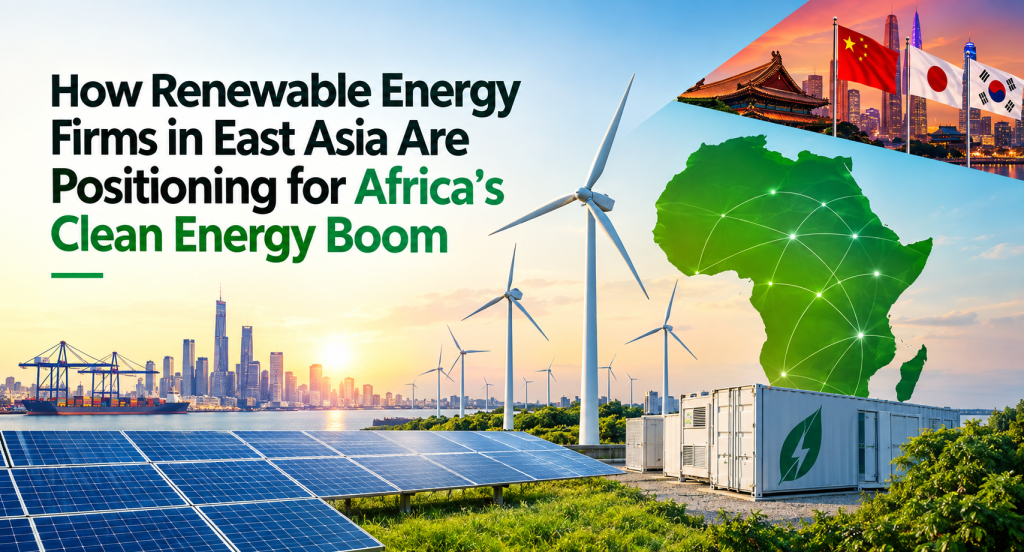
In practice, this is less a straight China-versus-Korea rivalry than two different bets on where the value sits in Africa’s transition. China is competing hard in the solar hardware layer, exporting panels, inverters, and batteries at scale. South Korea is largely staying out of that fight and targeting the infrastructure and engineering side instead, from plant rehabilitation and transmission upgrades to future clean-fuel supply.
China’s activity is now driven less by state development finance than the diplomatic headlines suggest. Chinese development finance institution spending on Africa’s energy sector has fallen by more than 85% over the past decade, according to the IEA, even as private Chinese manufacturers have become far more aggressive exporters.
The shift is structural, not rhetorical. JinkoSolar and LONGi both posted widening losses through the first half of 2026 as persistent oversupply and weak module prices continued to squeeze the industry, according to pv magazine’s coverage of the sector. Exporting into fast-growing markets like Nigeria has therefore become an increasingly important outlet for manufacturers under pressure at home.
The 2024 Forum on China-Africa Cooperation still produced a $51 billion pledge and a commitment to 30 new clean energy projects. But the pattern on the ground increasingly looks like private manufacturers moving inventory into Africa while trying to survive a difficult market at home.
South Korea’s presence, at least based on public deal activity, is far smaller in volume but sits in a different part of the value chain.
In November 2025, Doosan Enerbility and KEPCO KPS signed an agreement to jointly pursue power plant projects across Central Asia, Africa, and Southeast Asia. The focus is specifically on modernising ageing power plants rather than selling new-build hardware.
In Namibia, the flagship Hyphen green hydrogen project has secured a memorandum of understanding with South Korean firm Approtium as an offtake partner, alongside Germany’s RWE and Japan’s ITOCHU. That positions Korea as an anchor customer securing future energy supply rather than a hardware exporter.
Seoul’s government-level frameworks, including the $14 billion export financing pledge from the 2024 Korea-Africa Summit and the Korea-Africa Energy Investment Framework backing transmission projects in Kenya and Ethiopia, appear designed to support this kind of engineering-services and offtake-led entry.
Africa’s push toward local manufacturing cuts differently for each competitor.
For Chinese firms, it means more pressure to co-locate assembly, share technology, or accept thinner export margins as Nigerian- and Ethiopian-made panels start competing with imports on their own turf.
For Korean firms, which ship little hardware to begin with, Africa’s local assembly push is a gap they can build around, not a competitive threat to manage. Plant modernisation and transmission work don’t compete with a country’s assembly ambitions.
Each strategy also carries its own exposure. China’s is overcapacity. The same manufacturers exporting aggressively today are doing so because they’re losing money at home, and a recovery in Chinese domestic demand or a serious local-content backlash in a market like Nigeria could blunt that export push quickly.
Korea’s challenge is scale and patience. Engineering-services and offtake deals address a much smaller market than panel sales. They also take longer to move from agreement to installed capacity and compete with Chinese state-owned firms such as PowerChina, which also bids on large African engineering contracts, as well as Japanese partners already involved in some of the same hydrogen deals.
Hyphen’s own timeline, with first ammonia output not expected before 2028, shows how much slower this route is than shipping a container of panels.
See How WhirlSpot Media Can Drive Real Growth for Your Brand
- Content & PR – build authority, visibility, and trust across digital channels.
- Performance Marketing – data-driven campaigns focused on measurable ROI and demand generation.
- Corporate Events & Product Launches – plan and execute high-impact launches and brand events
The Credibility Gap: What This Means for PR in Nigeria and Africa
Financing structure decides who gets into a market. Trust is earned separately, and it follows different rules. That’s where the two strategies start to diverge in ways capital alone can’t resolve.
A Chinese manufacturer selling directly into Nigeria’s crowded solar retail market carries an exposure that a Korean firm signing a government offtake agreement doesn’t. Its brand is on every panel a household buyer sees underperform, every battery that degrades faster than promised, and every warranty claim that goes unanswered once the distributor has moved on.
Buyers of unfamiliar solar equipment carry real risks over the system’s working life: installation failure, battery degradation, spare parts that disappear with the distributor. That pattern shows up consistently in Nigerian consumer accounts of solar purchases and is one of the primary reputational risks facing any new hardware brand in this market.
Whirlspot Media’s own experience with EcoFlow, a Chinese portable power and renewable-energy brand, illustrates what that kind of trust-building actually looks like in practice. When EcoFlow launched its RIVER 3 Max Plus in Lagos in March 2025, coverage ran across outlets including Techpoint Africa, TechCabal, The Guardian Nigeria, and Punch, alongside broadcast segments on Arise News and TVC News.
The launch event generated the first wave of coverage, but the campaign Whirlspot built around it went further, positioning EcoFlow’s Nigeria Business Development Manager as a recurring industry commentator on television programmes discussing renewable energy solutions to Nigeria’s power crisis, according to Whirlspot’s own account of the campaign. That combination of credible local voices addressing policy and practicality, not just a single product launch, is what building brand equity for a consumer-facing manufacturer actually looks like on the ground.
Engineering performance creates the basis for trust. Communications is how that performance gets demonstrated, understood, and defended, and how a brand recovers its footing when something goes wrong. The two aren’t separable: a product that performs well but is never explained, never present in local media, and unreachable when a fault emerges carries the same reputational risk as one that underperforms outright.
The two models are selling trust to entirely different audiences, and that determines almost everything about what the communication strategy should look like.
A consumer-facing manufacturer needs installers, distributors, technicians, and everyday buyers to vouch for it, online and off. A government-facing engineering or offtake partner needs ministries, utilities, project partners, and host communities to see it as dependable over a multi-year contract.
For a foreign company operating in either category, what credibility-building looks like in Nigeria’s energy sector depends entirely on which model it’s running. For a manufacturer selling to households, that could mean local case studies, plain-language warranty terms, and service networks people can actually reach. For an infrastructure partner selling to governments, it means transparent community engagement and clear public communication about what a deal actually commits a country to.
Foreign brands entering Nigeria have faced this question before: Japanese tech companies, Chinese phone manufacturers, fintech platforms. In those categories, a failure shows up as a bad review. For a solar system or a power plant, it shows up as a financial loss built into a home or a grid. The question of trust is the same; the stakes are considerably higher.
Frequently Asked Questions
What’s driving the current clean energy investment boom in Africa? Grid failures, the removal of fuel subsidies, and falling solar technology costs are the immediate drivers, more than climate policy on its own. Private clean energy investment across Africa grew from about $17 billion in 2019 to almost $40 billion in 2024, according to the IEA, though the continent still receives only about 2% of global clean energy funding.
Which African markets are attracting the most renewable energy interest? Much of the current renewable energy activity is concentrated in Nigeria, Egypt, Kenya, South Africa, Morocco, and Namibia, for different reasons. Nigeria and Kenya are driven by grid failure and off-grid demand. Egypt and Morocco have strong utility-scale project pipelines, while Namibia is attracting attention because of its green hydrogen export potential rather than domestic electricity demand.
How are Asian renewable firms differentiating themselves from Western competitors? Chinese firms are competing largely on manufacturing scale, price, and export capacity, pressured in part by oversupply at home. South Korean firms are pursuing engineering, infrastructure, and offtake opportunities, positioning themselves in a different segment of the value chain rather than competing directly on hardware volume. Both approaches differ from the project-finance-heavy models common among many Western development institutions.
Building the Trust That Capital Can’t Buy
China’s manufacturing scale, combined with the pressure of its oversupply crisis, makes its price advantage in African solar hardware difficult to dislodge in the near term, regardless of how quickly Nigeria, Ethiopia, and South Africa grow local assembly.
Korea is targeting a different layer entirely, and competing on panel volume was never the plan. Its bet is that engineering services, plant rehabilitation, and long-term offtake agreements like Hyphen’s are worth more over a project’s lifetime than winning the hardware price war, even if that bet moves slower and faces competition from Chinese and Japanese players working on the same deals.
Africa’s local manufacturing push suggests the continent is aiming to become more than an import destination. For now, though, it is building assembly capacity on top of imported components rather than creating an independent supply chain. Dependence on Chinese inputs will likely persist even as African-made panels start crossing borders.
Trust is the variable that determines how much of either country’s capital actually becomes installed, paid-for capacity that can still withstand scrutiny when something breaks. That trust has to be earned separately with households and with governments.
The real communications opportunity for manufacturers and infrastructure partners alike is translating technical capability, local partnerships, project performance, and after-sales commitments into evidence that a household in Kano or a ministry in Windhoek can actually check for itself. That’s a different brief from a standard corporate announcement, and it requires someone who knows both the market and the audience.
If your organisation is entering Nigeria’s or Africa’s renewable energy market, whether as a hardware exporter, an infrastructure partner, or somewhere in between, Whirlspot Media builds the on-the-ground credibility strategy that turns capital and technical capability into a brand Nigerians and African governments can actually verify and trust. Talk to us: hello@whirlspotmedia.com