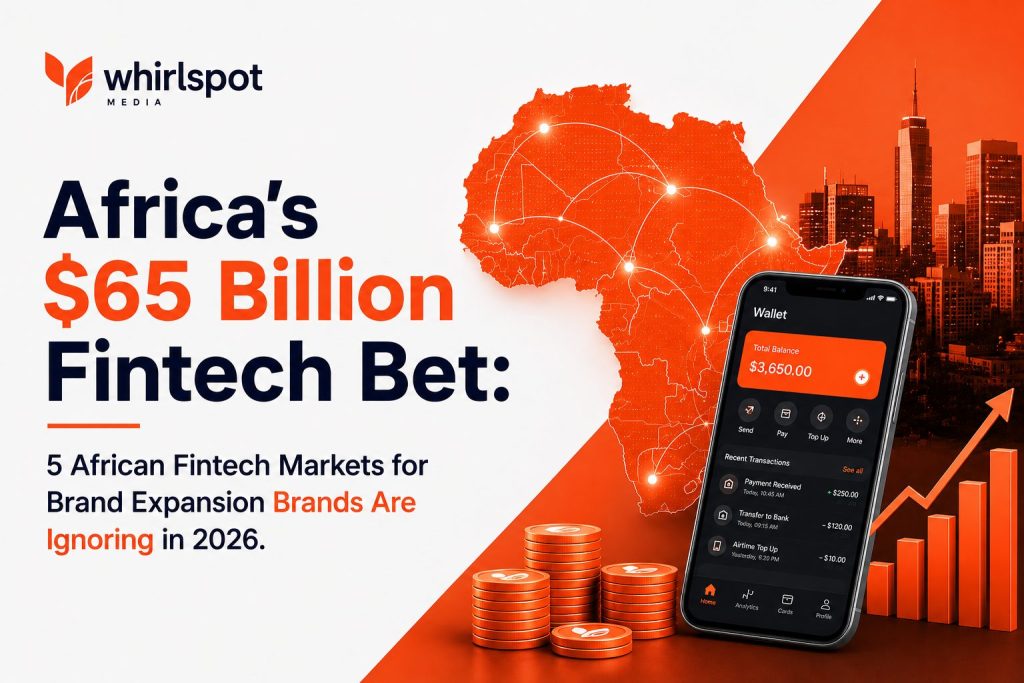

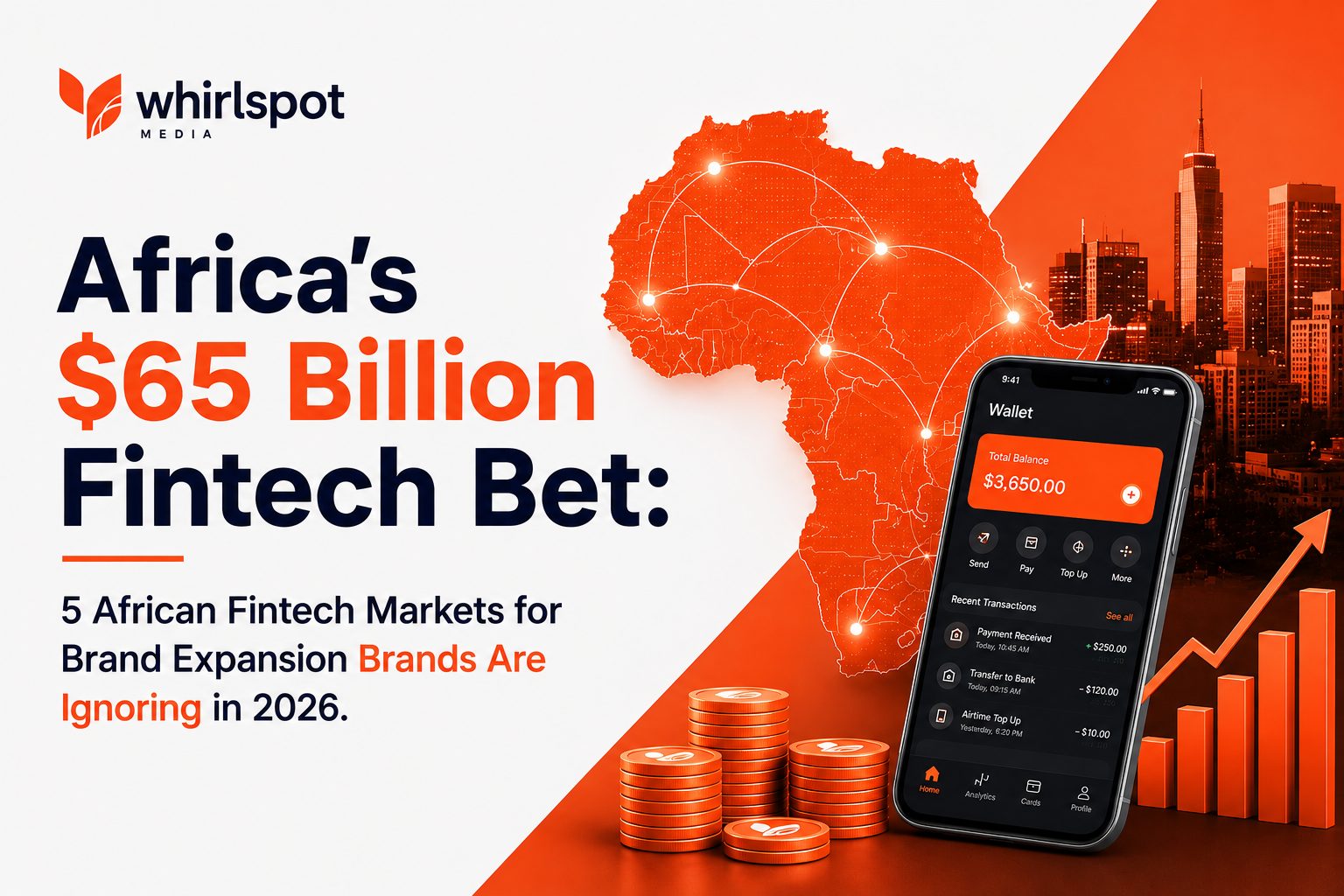
The five leading African fintech markets for brand expansion in 2026 are Egypt, Rwanda, Ghana, Ivory Coast, and Ethiopia: each offering distinct infrastructure maturity, regulatory conditions, and consumer digitization timelines that directly shape when and how foreign brands should enter.
Here is the thing about Africa’s fintech story that most brand strategy decks get wrong. They open with Nigeria, move to Kenya, mention South Africa as a footnote, and call it “comprehensive African coverage.” It is not. Treating Africa as a single fintech market is one of the most expensive strategic errors a brand or investor can make — and yet it happens constantly, even among teams that should know better. African Business
Africa has officially emerged as the fastest-growing fintech market globally, with revenues projected to expand thirteenfold to approximately $65 billion by 2030. That headline is real. But it obscures something more useful: the African fintech markets for brand expansion that are doing the structural work right now — building the payment rails, clearing the regulatory runway, and digitizing consumer behavior at speed — are not always the ones getting the most press coverage. PAN AFRICAN VISIONS
This piece is about those five markets. Not the obvious ones. The ones where the foundation is being laid while everyone else is still staring at Lagos.
Why the Second Wave Changes Everything
While the continent already accounts for 74% of global mobile money transaction volume, new analysis shows that the next stage of growth will be defined less by transaction scale and more by financial depth, institutional design, and long-term investment readiness. PAN AFRICAN VISIONS
That shift is significant for brands, not just fintechs. The first wave — mobile payments, financial inclusion, peer-to-peer transfers — got money moving for people who had no access to formal banking. That chapter is largely written. What comes next is credit infrastructure, embedded finance, B2B payment rails, and the digitization of trade. When those systems mature in a market, it changes the economics of operating there for every brand that relies on distribution partners, supply chains, or digital commerce.
Follow the fintech infrastructure. The consumer opportunity is usually 18 to 24 months behind it.
Market 1: Egypt — The Continent’s Most Underrated Entry Point

Egypt’s fintech ecosystem in 2026 is one of the most mature on the continent, one of the most profitable at the top of the pyramid, and structurally one of the most interesting. And yet, when foreign brands build their Africa entry strategy, Egypt often sits in a separate mental category — filed under “Middle East/North Africa” rather than “Africa” — which is exactly why it is underutilized. Allbusiness
With roughly 180 fintech startups representing fivefold ecosystem growth in five years, a $750–800 million fintech and digital payments market, and a $7 billion broader digital banking ecosystem, Egypt has evolved from payments adoption to full-scale digital financial infrastructure. Financial inclusion has reached nearly 75% of the population. Africafinforum
The infrastructure story is particularly compelling. In August 2025, Banque Misr’s Misr Digital Innovation received approval to transition into onebank, Egypt’s first fully digital-native bank, with products and services expected to go live in 2026 through exclusively digital channels — a move widely viewed as a market inflection point under the Central Bank of Egypt’s digital banking direction. Chambers and Partners
For brands, that inflection point matters. Egypt has 116 million mobile subscriptions and over 90 million internet users. It also serves as a natural bridge between African and Gulf markets — which means a brand that lands well in Cairo is also speaking to a much wider regional audience than the geography alone suggests.
See How WhirlSpot Media Can Drive Real Growth for Your Brand
- Content & PR – build authority, visibility, and trust across digital channels.
- Performance Marketing – data-driven campaigns focused on measurable ROI and demand generation.
- Corporate Events & Product Launches – plan and execute high-impact launches and brand events
Market 2: Rwanda — The Smartest Place to Test Anything
Rwanda has positioned itself as a focal point for ecosystem alignment across East Africa, supported by forward-looking regulation, interoperable digital public infrastructure, and a clear cross-border orientation. Recent initiatives — including the Licence Passporting Memorandum of Understanding between Rwanda and Kenya — are cited as practical steps toward lowering the cost to scale for financial institutions, easing regional expansion, and improving cross-border payment and credit flows. PAN AFRICAN VISIONS
Rwanda is small. The consumer market is not what draws serious brands there. What draws them — or should — is the regulatory environment. Rwanda remains underutilised as a testing ground for regulatory strategy. Its licensing is modular, supported by a formal sandbox framework that lowers barriers to entry, making it one of the most attractive environments on the continent for early-stage pilots and compliance testing. While its market size is limited, it offers investors a valuable proof-of-concept environment that reduces risk before expansion into larger economies. African Business
Think of Rwanda as the corridor. Get your product, pricing, and compliance architecture right in Kigali, then follow the passporting agreement into Nairobi. It is a significantly cheaper and lower-risk sequencing than going straight into Nigeria or Kenya and discovering structural issues at scale.
Market 3: Ghana — The Quiet One with Real Depth

Ghana does not get the headlines it deserves. It should.
Ghana’s fintech sector attracted over $150 million in venture funding between 2020 and 2025, with startups tackling mobile money interoperability, last-mile payments, credit scoring, insurance, and cross-border remittances. The Bank of Ghana’s regulatory sandbox and GhIPSS instant pay rails have created an environment where startups can test, scale, and integrate with telcos and banks. JBKlutse Foundation
The GhIPSS infrastructure is genuinely impressive in terms of what it enables at the ground level. GhQR transaction values grew by 80.56% in 2025, from 7.16 billion cedis to 12.92 billion cedis — and that growth is not hypothetical. It is showing up in how people pay for groceries, transport, and everyday retail. Modern Ghana
Ghana is also English-speaking, has a politically stable operating environment relative to many of its neighbors, and has a growing middle class that is increasingly comfortable with digital commerce. For foreign brands that need an anglophone West African market outside of Nigeria’s regulatory complexity, Ghana is the most underrated option on the continent. The fintech infrastructure being built there today is the floor on which digital commerce will run for the next decade.
Market 4: Ivory Coast — Where Francophone Africa’s Money Is Pooling
Côte d’Ivoire has become the financial anchor of Francophone West Africa, contributing 40% to WAEMU’s GDP and sustaining growth close to 6% for over a decade. Abidjan is where the serious money in French-speaking West Africa goes — and that concentration is accelerating. MEXC
The proof is in who is arriving. Barely two months after Nigeria’s Zenith Bank opened its first-ever Francophone African subsidiary in Côte d’Ivoire in April 2026, Mauritius Commercial Bank announced plans to establish operations in the country — the latest evidence that Africa’s banking heavyweights are converging on Abidjan, betting that the country’s industrial transformation and investment boom will power the next phase of banking growth in West Africa. Businessday NG
In July 2026, Ivory Coast secured $80 billion in international public financing for its National Development Plan 2026-2030 — four times more than expected. The Rio Times
On the consumer side, Orange Money is the largest mobile platform with more than 13.83 million subscriptions, followed by MTN MoMo with over 8.46 million subscriptions — giving brands a ready consumer base that is already transacting digitally. The CFA franc’s euro peg also reduces currency risk in a way that makes Ivory Coast financially attractive to brands that have been burned by volatile African currencies elsewhere. SBS
Market 5: Ethiopia — Long Game, Massive Payoff
Ethiopia is no longer just a cheap-labor hypothesis for multinationals. It is rapidly becoming a structurally investable jurisdiction — post-float, trade-opened, AfCFTA-live, IMF-anchored, and WTO-bound. D’Andrea & Partners
The scale is the argument. Ethiopia has a population north of 125 million. Its nominal GDP is expected to hit $121 billion in 2026. Mobile money transactions — only 12 million in 2020 — surpassed 139 million by 2025 and continue rising. The digital economy contributed at least $10 billion to GDP in 2023, a figure that will keep climbing as reforms compound. Capital Newspaper
Ethiopia’s fintech story is not one of overnight transformation. In 2026, Ethiopia’s fintech landscape sits at an inflection point — the foundations are being laid, the regulatory environment is evolving, and a new generation of digital financial services is beginning to emerge. The Fintech Times
That is precisely the right time to be paying attention, not the moment after everything has already matured and competition has arrived.
What This Means for Brand Entry

There is a pattern that repeats across every one of these markets. Digital payment infrastructure matures. Consumer confidence in digital transactions increases. E-commerce and digital services spend goes up. Then foreign brands that have already established local presence and brand awareness capture a disproportionate share of that consumer spending.
The mistake most brands make is waiting for the consumer spending phase before they build their presence. By then, competitors have already been in-market for two years, have local media relationships, have earned consumer trust, and have figured out the logistical and regulatory shape of the market. The brands that win Africa in 2028 and 2030 are building awareness and credibility right now, in 2026 — during the infrastructure phase — not after it.
As WhirlSpot has covered in our guide to entering African markets as a foreign brand, the brands that treat Africa seriously enough to build earned media, local partnerships, and culturally adapted communications before the crowd arrives consistently outperform those that try to buy their way in late.
For a deeper read on the BCG “Beyond Payments” thesis that underpins this entire analysis, start with their full framework on Africa’s second fintech wave.
A strong product and a proven playbook are not enough — applying a Kenyan strategy in Nigeria, for example, is not simply challenging; it can result in compliance bottlenecks, inefficient capital deployment, and ultimately, failure. The same principle applies at the continent level. A brand that maps “Africa” without understanding which fintech markets are maturing where — and on what timeline — is not doing African market strategy. It is doing wishful thinking with a map. African Business
The five African fintech markets for brand expansion outlined here are not the loudest on the continent. That is the point. The quiet ones, where infrastructure is being built and consumer behavior is shifting before the global spotlight arrives, are where the real brand-building advantage lives.
By the time the rest of the world catches up to Egypt, Rwanda, Ghana, Ivory Coast, and Ethiopia, the window to enter without a crowd will be closed. It is open right now.
Want to think through what market entry looks like practically for your brand? Explore our African markets for brand expansion breakdown or read our guide on launching a business in Africa. And if you are mapping digital infrastructure signals to brand strategy timing, our piece on Nigeria’s $770M data center surge shows exactly how to read those signals.
At Whirlspot Media, we tell Africa’s economic story with the depth it deserves, cutting through noise to deliver insights that actually move the needle. If you found this article valuable, send us an email at hello@whirlspotmedia.com for partnership on research-driven content on African markets, business, and policy.