
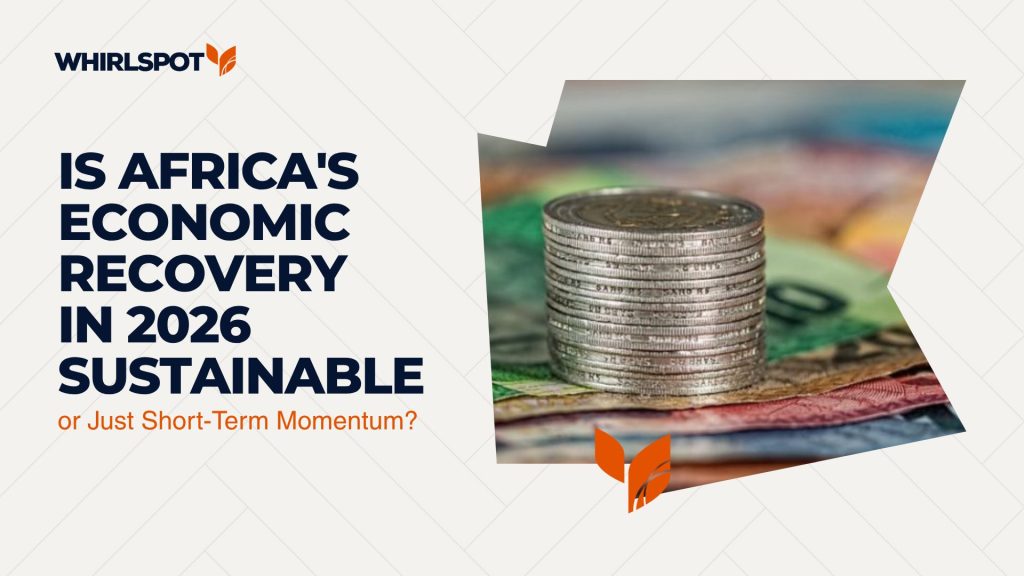
Africa has heard the “rising continent” narrative so many times that it almost feels like a slogan. But in Africa economic recovery 2026, the numbers are doing something different. They’re showing up. The question is whether they’ll stick around.
Sub-Saharan Africa entered 2026 with the strongest economic momentum it had seen in a decade. The region clocked its fastest growth rate in 10 years, 4.5% in 2025, driven by reduced macroeconomic imbalances, rising investment levels, and a broadly supportive external environment. Countries like Ethiopia, Côte d’Ivoire, Rwanda, and Benin were outpacing the global average by a wide margin.
Before we interrogate the sustainability question around Africa economic recovery 2026, we need to acknowledge what actually happened to get to this point.
In 2025, growth accelerated across nearly all country groups in Sub-Saharan Africa, underpinned by both favourable external conditions and, critically, sound domestic policy choices. Countries such as Ethiopia and Nigeria reaped the benefits of macroeconomic reforms: exchange rate realignments, subsidy reductions, and strengthened monetary policy frameworks. Inflation fell to a median of 3.4 % by the end of 2025, fiscal deficits narrowed, public debt declined, and current account balances improved.
These were not accident-of-circumstance gains. African policymakers made difficult, politically costly decisions, and they paid off. That context matters enormously when assessing whether this recovery has legs.
The IMF’s latest economic outlook projects that Africa economic recovery 2026 will see average GDP growth of 4.3 %, positioning the continent as the fastest-growing region globally. In a world where advanced economies are grappling with demographic stagnation, tight fiscal constraints, and slowing trade, Africa’s growth story stands out not because it is perfect, but because it is real and increasingly reform-driven.
Africa Economic Recovery 2026: Where the Cracks Are Showing
Africa’s improving outlook remains fragile amid global uncertainty, with high debt-servicing costs, limited fiscal space, and volatile commodity prices continuing to weigh on prospects for inclusive and sustainable growth.
Africa’s average public debt stands at around 63% of GDP, with interest payments consuming close to 15% of government revenue in many countries. Around 40% of African countries are either already in debt distress or at high risk of falling into it.
Add to that a global geopolitical wildcard. The war in the Middle East has caused a rapid increase in key commodity prices, particularly in fuel and fertiliser. Oil importers, many of them low-income or fragile states, face worsening trade balances and rising living costs, while inflation is projected to rise across the region.
There is also the foreign aid cliff that few are talking about loudly enough. The sharp, unprecedented decline in official development assistance appears more structural than cyclical this time, and it is falling hardest on the region’s most vulnerable countries: fragile states and low-income economies that depend on aid not as a supplement, but as a critical source of budget financing, healthcare, and food assistance.
See How WhirlSpot Media Can Drive Real Growth for Your Brand
- Content & PR – build authority, visibility, and trust across digital channels.
- Performance Marketing – data-driven campaigns focused on measurable ROI and demand generation.
- Corporate Events & Product Launches – plan and execute high-impact launches and brand events
The Divergence Story Nobody Tells You
Here is what the continental average conceals: Africa is not growing at one speed.
East Africa is the clear standout — regional growth hit 5.3% in 2025 and is projected at 6.1% in 2026. Kenya, Tanzania, Uganda, Rwanda, and Ethiopia are all tracking above the continental average, with Rwanda forecast to be the fastest-growing major economy on the continent at 7.0% in 2026.
Meanwhile, Southern Africa lags at approximately 2.0%, constrained by structural challenges and energy shortages, while Central Africa is expected to grow by around 3.0%.
This divergence is the real story for investors, businesses, and policymakers. Africa’s economic recovery in 2026 is a collection of very specific country-level bets. Decisions on expansion, capital allocation, and partnerships increasingly depend on choosing the right countries and sub-regions rather than adopting a broad “Africa strategy.”
What Would Make This Recovery Sustainable?
Sustained growth in Africa requires more than favourable commodity cycles or a single year of disciplined fiscal policy. Three things will determine whether 2026 is a turning point or a false peak:
1. Structural Reform Must Deepen: Africa’s growth challenge is fundamentally structural, reflected in low investment, weak productivity, and limited job creation. The African Union’s benchmark of 1 per cent of GDP invested in R&D remains unmet in most Sub-Saharan African countries, most of which spend between just 0.1 and 0.4%. Innovation, skills, and industrialisation cannot be imported. They must be built.
2. Trade Integration Must Accelerate. Progress in implementing the African Continental Free Trade Area (AfCFTA) has been slow and uneven, while the expiry of the African Growth and Opportunity Act (AGOA) poses challenges for exporters, particularly in the clothing sector. Intra-African trade remains one of the continent’s most underdeveloped assets — and one of its biggest opportunities.
3. The Private Sector Must Fill the Aid Gap. As development assistance contracts, the private sector must step up. Energy and power remain central; investments in renewables, grid stability, and power generation are critical to unlocking industrial growth and improving operating conditions for businesses across the continent.
Conclusion
Africa economic recovery 2026 is neither pure hype nor guaranteed success. The optimism that greeted 2026 was earned through years of difficult but necessary reform. The choices African policymakers make now — whether to hold the inflation line, protect the vulnerable, and resist the temptation to unwind the reforms that got them here — will determine whether these hard-won gains endure.
The foundation is stronger than it has been in a decade. The headwinds are real. And the outcome will be determined not by external luck, but by internal resolve.
Africa is not just recovering. It is recalibrating. The question is whether institutions, investors, and governments move fast enough to match the moment.At Whirlspot Media, we tell Africa’s economic story with the depth it deserves, cutting through noise to deliver insights that actually move the needle. If you found this article valuable, follow our LinkedIn Page for sharper, research-driven content on African markets, business, and policy.