
The world’s most important oil chokepoint just closed, and Africa’s oil producers are sitting on one of the biggest strategic opportunities in a generation. The question is: what form of strategic storytelling is being used?
When US and Israeli strikes on Iran triggered the closure of the Strait of Hormuz in early March 2026, the global energy sector went into shock. The blockade of the Strait of Hormuz, the route of approximately 20% of the world’s seaborne crude oil and LNG exports, has kept energy supply dangerously tight, with the International Energy Agency characterising the situation as the “greatest global energy security challenge in history.” Brent crude surged. In March, Brent soared above $95 per barrel, occasionally reaching around $110. Importing nations from Tokyo to Berlin scrambled for alternative supplies.
And right there, sitting outside the conflict zone, with open Atlantic and Mediterranean export routes, proven reserves, and production infrastructure already in place, were Africa’s oil-producing nations: Nigeria, Angola, Algeria, Libya, the Republic of Congo, Gabon, and Equatorial Guinea.
The question is not whether Africa has what the world needs. It clearly does. The question is whether Africa’s oil producers are using strategic storytelling to communicate it with the urgency, clarity, and confidence the moment demands.
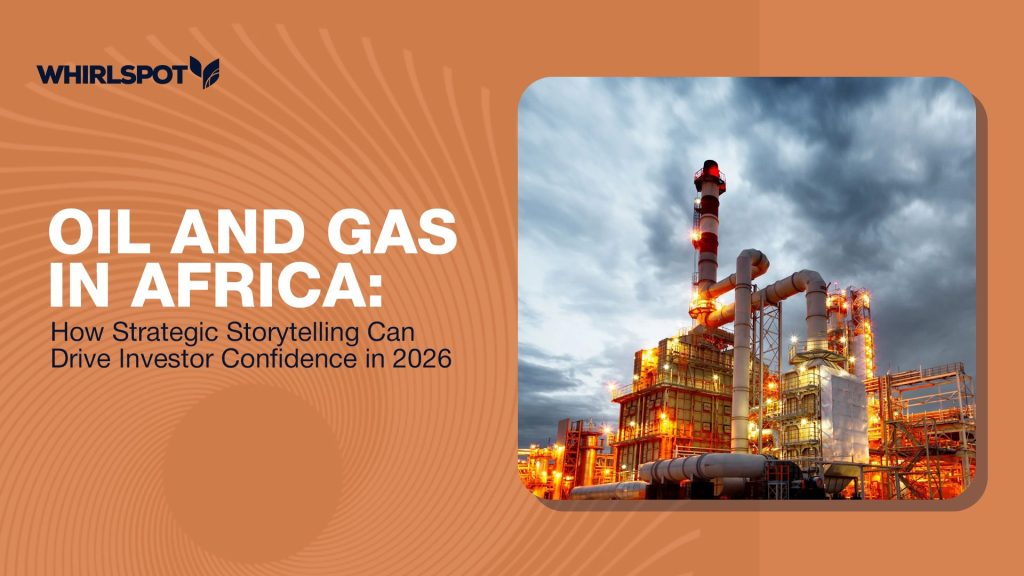
Africa’s Atlantic Advantage Is a Geopolitical Fact
From Nigeria’s Gulf of Guinea terminals to Libya’s Mediterranean ports and Angola’s Atlantic infrastructure, Africa’s crude exports are uniquely insulated from the bottlenecks that constrain Middle Eastern supply. Unlike oil that must transit vulnerable corridors such as the Strait of Hormuz, Bab el-Mandeb or the Suez Canal, African production is already positioned along open Atlantic and Mediterranean routes, making a barrel of African crude not just a commodity, but a secure supply.
The quality of African crude oil, particularly in Nigeria and Angola, also matches that of Iranian crude oil. In previous crises in the Middle East, importers had turned towards these countries to fill the gap. History is repeating itself, but at a scale the continent has never seen before.
The Dangote Petroleum Refinery is rapidly transforming Nigeria from a dependent importer into a regional powerhouse, leveraging its full 650,000 bpd capacity, recently selling 12 cargoes of refined products, amounting to 456,000 tonnes, to Côte d’Ivoire, Cameroon, Tanzania, Ghana and Togo. Algeria, with its pipeline network into Europe and long-standing contracts with Italy and Spain, has entered talks with Italy and Spain and is fielding enquiries from other countries, including Vietnam, as Europe scrambles to replace Gulf supply.
These are not small wins. These are historic pivots. Yet too many of these stories are being told as footnotes, rather than the headlines they deserve to be.
See How WhirlSpot Media Can Drive Real Growth for Your Brand
- Content & PR – build authority, visibility, and trust across digital channels.
- Performance Marketing – data-driven campaigns focused on measurable ROI and demand generation.
- Corporate Events & Product Launches – plan and execute high-impact launches and brand events
The Perception Gap Is Costing Africa Billions
Even with Brent above $95, even with the Strait of Hormuz closed, even with Europe and Asia desperately seeking alternative supply, Western financial institutions continue to retreat from fossil-fuel financing, and many investors remain cautious about perceived risks in emerging markets. That caution does not disappear overnight because of a geopolitical crisis. It shifts, but only for the operators and governments that are actively making their case using strategic storytelling.
Africa holds over 125 billion barrels of proven oil reserves, yet the continent still faces an annual energy investment gap of $31 billion to $50 billion. The gap between what Africa has and what it receives in capital is not primarily a resource problem; it is a communications and credibility problem. It is the strategic storytelling gap, and it has never been more costly than right now, when the window is wide open.
What Strategic Storytelling Actually Means for Oil Producers Right Now
Strategic storytelling is not glossing over legitimate risks or producing glossy brochures that investors see through in five minutes. Strategic storytelling, done well, is the disciplined, data-led communication of a project’s value, a country’s reform momentum, and a sector’s transformational potential packaged in ways that resonate with the specific audiences who hold the capital.
This means translating geopolitical advantage into investor-ready language, contextualising why Angola’s $70 billion investment pipeline, Nigeria’s Petroleum Industry Act, and the Republic of Congo’s Gas Master Plan represent stable, long-term plays for structural supply security in a world that can no longer take the Gulf for granted.
As capital becomes increasingly selective and investors prioritise technical certainty alongside fiscal stability, detailed subsurface intelligence and operational efficiency are now core investment criteria. Your communications strategy must evolve at the same pace as your drilling programme.
Three Storytelling Strategies That Move Capital in 2026
1. Lead with route security: The Iran war has made the security of supply routes the single most compelling investment argument in global energy markets today. Nigeria’s Niger Delta export terminals at Bonny, Forcados and Qua Iboe, Angola’s Port of Luanda and Lobito corridor, and Libya’s Mediterranean terminals at Ras Lanuf and Es Sider all export directly into routes untouched by the Hormuz crisis. It is important to lead with this competitive advantage.
2. Frame reform as de-risking: Investors want stability as much as they want barrels. Stable fiscal regimes, predictable contract terms, and anti-corruption measures help de-risk projects and give investors the confidence to commit long-term capital. Countries and operators that lead their investor communications with governance reform and fiscal transparency are consistently outperforming those that lead with production numbers alone. Algeria’s Sonatrach, Nigeria’s post-PIA licensing rounds, and Angola’s streamlined approvals. These are stories of de-risking; tell them as such.
3. Show up at the platforms that move capital: Platforms like African Energy Week play a critical role in translating policy and reform into action, bringing together governments, investors and operators to announce licensing rounds, upstream agreements and midstream commitments, while facilitating policy dialogue on stability, regulatory certainty and investment priorities.
Conclusion
The Iran war and the broader reverberations in the Middle East are not just reshaping the geopolitical security landscape, but they are also changing Africa’s commercial ties to the world. The structural shift in how Europe, Asia, and North America source energy is accelerating. This is a more selective, commercially disciplined re-entry into African markets by global oil majors focused on assets that can compete in a more volatile, capital-constrained world.
Rising oil prices are promising additional revenue for exporters such as Angola, Nigeria, Algeria, Libya, the Republic of the Congo, Gabon, and Equatorial Guinea, with renewed investor interest in the oil and gas sector, as high prices typically revive enthusiasm for exploration and new extraction projects. But temporary price windfalls do not automatically translate into long-term investment partnerships. Those are built on trust, credibility, and strategic communication.
At Whirlspot Media, we work with energy operators, government stakeholders, and sector leaders who understand that a great project without a great story is invisible. We have seen firsthand what becomes possible when the right message reaches the right decision-maker at the right time.
Africa’s oil producers have never had a more powerful story to tell. The world is watching, listening, and urgently looking for what Africa has. Now is the time to invest in telling that story with precision and confidence to convert this moment into decades of capital partnerships.
If you are an oil-producing operator, a national oil company, or a government energy stakeholder looking to sharpen your investor communications strategy in 2026, send us an email at hello@whirlspotmedia.com
At Whirlspot Media, we help African energy businesses build the narratives that open doors, close deals, and establish lasting credibility in global markets from thought leadership and content strategy to media positioning and investor-facing communications.